
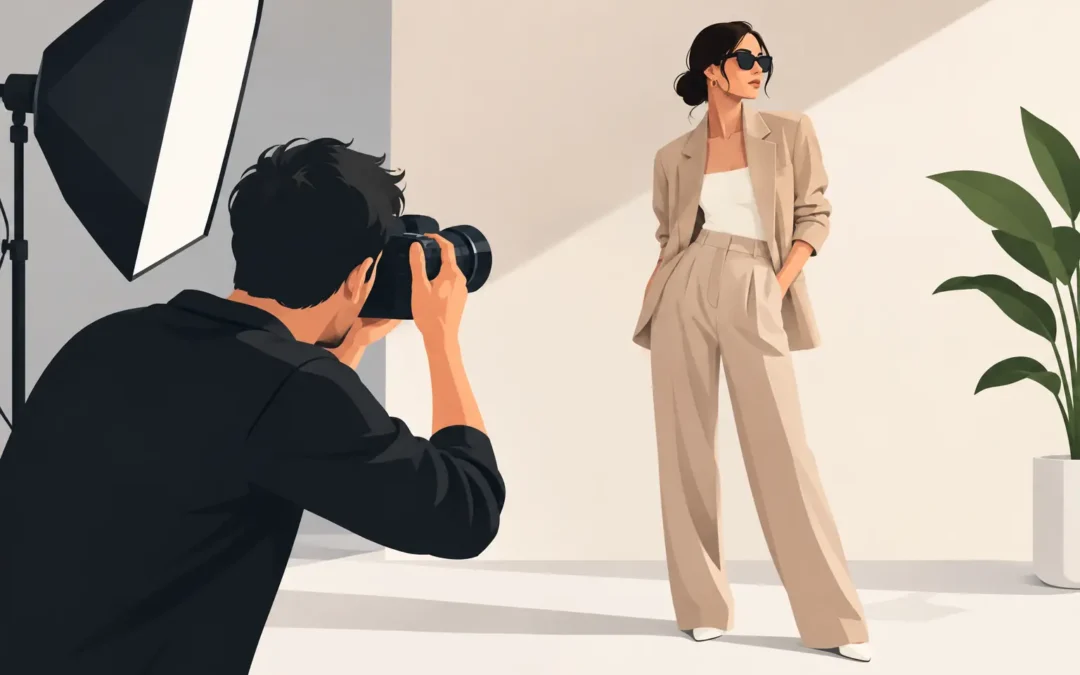
A strong example of fashion photography does not simply show a garment clearly. It creates a reason to look at it. The clothing, subject, light, location, and frame work as one visual proposition: this is who the person could be, where they belong, and why the image matters now.
For an editorial team, creative director, or brand, that distinction is practical. A clean product image can describe a piece. Fashion photography gives the piece cultural temperature. It can make an established label feel newly relevant, introduce an emerging designer through a distinct visual language, or give a public figure a more dimensional presence than a standard press portrait allows.
What Makes an Example of Fashion Photography Effective
Fashion photography is often mistaken for a category defined by wardrobe alone. A well-dressed subject against a plain wall may be a fashion photograph, but it is not automatically a memorable one. The image needs an organizing idea, even when that idea is quiet.
Consider a portrait of a musician in a sharply tailored suit. If the frame is front-facing, evenly lit, and built for maximum legibility, it may serve a publicity need. Shift the subject into a low-lit hotel corridor, turn their attention away from camera, and let the architecture compress the frame. The suit now has tension. It carries a mood – private, cinematic, slightly withholding. The viewer is not only registering the cut of the jacket. They are reading an atmosphere.
That is the central task. Fashion images turn styling into character and character into narrative.
The strongest work also holds two priorities in balance. The clothes must remain visible enough to serve the client, yet the image cannot feel like a catalogue page unless that is the intended visual language. Too much atmosphere can obscure the product. Too much product clarity can drain the image of desire. The right balance depends on the assignment, the publication, the audience, and the life the images will have after release.
Start With the Image, Not the Mood Board
Mood boards are useful shorthand, but references do not make a photograph coherent. Before selecting a location or building a lighting plan, establish what the picture must communicate.
A beauty story may ask for precision: texture, skin, color, and a direct relationship between face and camera. A luxury campaign may need space, restraint, and a sense of permanence. A streetwear editorial could be faster, closer, and more social, with movement that feels observed rather than staged. The same garment can occupy radically different worlds without losing its identity.
The question for the team is not, “What looks fashionable?” It is, “What visual condition makes this collection, person, or idea feel specific?” That decision guides everything that follows. It also prevents a familiar problem in commissioned image-making: a shoot full of individually attractive elements that never resolves into a point of view.
Casting Is Part of the Composition
Fashion casting is not a final production detail. It is a compositional choice made before the camera is raised. A subject’s physical presence, age, posture, face, and manner of occupying space will change how the clothing reads.
This matters especially when working with talent who already carry a public identity. A recognizable actor, artist, or writer arrives with associations that can either deepen the concept or overpower it. The most useful direction does not erase those associations. It gives them a new setting. A controlled portrait can preserve familiarity while introducing an unexpected degree of intimacy, irony, glamour, or vulnerability.
For brands, casting against expectation can be effective, but only when it has purpose. Novelty for its own sake dates quickly. A more enduring choice comes from a real relationship between the person, the clothes, and the tone of the story.
Light Establishes the Terms
Lighting tells the viewer how to approach an image. Hard flash can feel immediate, graphic, confrontational, or knowingly artificial. Window light may suggest closeness and observation. A shaped studio setup can make fabric, skin, and silhouette feel sculptural. None is inherently more sophisticated than another.
What matters is whether the light supports the premise. If the story is about polish and control, accidental-looking illumination may weaken it. If the concept depends on spontaneity, a heavily constructed lighting scheme can make the work feel over-managed. Fashion photography benefits from intention, including when the desired effect is apparent ease.
Light should also be evaluated in relation to use. A dramatic image that succeeds as a magazine opener may be less functional for a campaign requiring room for typography, alternate crops, and consistent digital assets. Building those needs into the shot list protects both the visual idea and the final deliverables.
The Frame Needs a Point of Tension
In a compelling fashion image, something is usually slightly unresolved. The subject may be looking beyond the frame. A shoulder may interrupt a clean line. The setting may be too grand, too ordinary, too close, or too empty for the clothes. That small friction keeps the photograph from becoming merely decorative.
This does not mean every frame needs theatrical drama. Stillness can be charged. A seated figure, a direct gaze, and one carefully placed hand may be enough when the proportions, shadows, and negative space are exact. The restraint has to feel chosen.
Location often provides this tension. A formal dress in a service corridor, refined tailoring in harsh daylight, or delicate styling in an unembellished domestic space can produce contrast without turning the image into a costume exercise. The location should complicate the clothes or extend their logic. It should not compete with them.
Movement Must Be Directed, Even When It Looks Accidental
Fashion images frequently rely on movement because clothes change when bodies move. Fabric catches air, hems shift, sleeves pull, and a silhouette becomes visible for an instant. But motion without direction can quickly read as generic energy.
Useful direction is often specific and physical: take two steps, stop before the mark, turn only with the shoulders, let the coat remain behind you, look past the lens. These prompts give a subject something playable rather than asking them to “be natural,” which is rarely a useful instruction under production pressure.
The best frame may arrive between poses, but it is usually made possible by preparation. The photographer needs to understand the garment’s behavior, the subject’s range, and the camera position before those unplanned moments can become usable images.
Editorial Fashion Photography and Campaign Photography Ask Different Questions
An editorial story has room for ambiguity. It may privilege one strange, beautiful frame over obvious garment coverage because the publication’s role is to build a world and start a conversation. A campaign has a different responsibility. It must create recognition, support a larger brand system, and remain effective across formats.
Neither approach is lesser. They simply require different discipline.
For editorial, a photographer can push further into character, juxtaposition, and visual risk. For a campaign, the creative team may need a clearer hierarchy: hero images, full looks, detail frames, landscape and vertical crops, space for copy, and a visual rhythm that can carry through multiple placements. The campaign can still be visually daring, but the daring has to survive repetition and adaptation.
A productive brief makes those priorities explicit. If a client wants the looseness of an editorial while needing campaign consistency, the solution may be a controlled visual system with room for variation: one lighting approach, a limited palette, and a defined relationship between subject and setting. Freedom works better when its boundaries are clear.
The Details That Separate a Polished Image From a Generic One
High-level fashion work is built from decisions that are easy to overlook at thumbnail size. The angle of a cuff, the shape of a hand, a wrinkle that either adds character or distracts, the distance between a subject and the edge of frame – each can alter the authority of a photograph.
Retouching belongs to that same discipline. The goal is not to remove every trace of reality. It is to protect the image’s intended surface. Skin, fabric, and environment should feel considered, not flattened into the same texture. Overcorrection can make an image less luxurious, not more.
Editing is equally decisive. A fashion story is rarely improved by showing every successful frame. Select images that shift perspective, sustain the visual language, and give the viewer a sequence with pace. One direct portrait, one full-length frame, one close detail, and one image that opens the world may say more than twenty variations of the same pose.
The lasting value of fashion photography is not that it follows a look of the moment. It is that it gives a collection, a face, or a publication a visual memory. When the concept is precise and the execution remains attentive to the person in front of the camera, the image continues to hold after the season has moved on.