
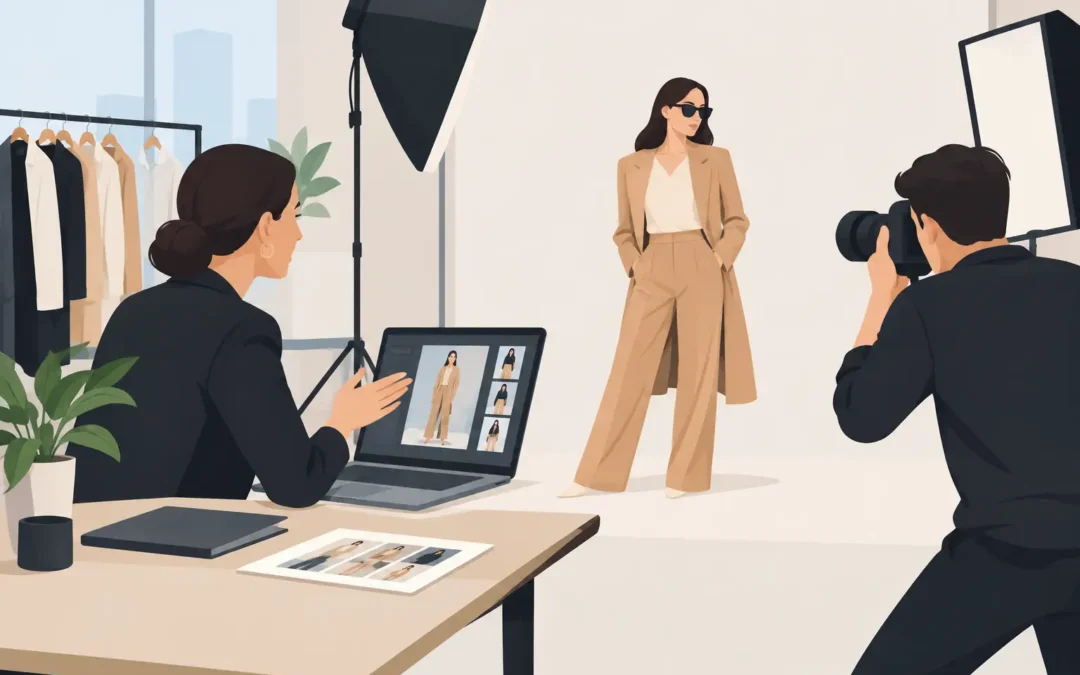
A strong fashion image can carry an entire season of communication, yet commissioning fashion photographers is often treated as a line item to be solved after the campaign has already been defined. The better approach begins earlier. Photographer, creative direction, casting, wardrobe, location, and intended use should inform one another from the first conversation.
For editorial teams, publicists, and brands, the assignment is not simply to obtain polished files. It is to make images that establish a point of view, give talent presence, and remain recognizable after the immediate release has passed. That requires a photographer whose work has authorship, along with a process that protects it.
Start With the Visual Question
A useful brief does more than name a mood. Words such as elevated, cinematic, raw, or editorial may be directionally helpful, but they are too broad to guide decisions on set. A photographer needs to understand what the images are meant to say about the subject, the collection, or the publication.
For a designer launch, the question may be how clothing moves through a particular world. For a profile, it may be how to portray a well-known person without reducing them to a familiar public image. For beauty, it may be whether the work should emphasize finish, texture, intimacy, or graphic form. These are different visual problems, even if each project is described as fashion.
Define the audience and where the work will live. A magazine feature, campaign, lookbook, social rollout, out-of-home placement, and press package each call for different framing, pacing, crop flexibility, and production scale. This does not mean every deliverable needs to dictate the image. It means the photographer should know the boundaries before deciding where to push beyond them.
References help when they communicate a sensibility rather than prescribe a replica. Share images that clarify light, proportion, casting energy, color, or compositional restraint. Then explain what draws you to them. The explanation is often more valuable than the reference itself.
Commissioning Fashion Photographers for a Point of View
A portfolio is evidence of more than technical proficiency. Look for a consistent relationship to faces, bodies, clothing, and atmosphere. Does the photographer make subjects feel observed or merely arranged? Is the lighting expressive without becoming the subject of every frame? Can the work move between beauty, portraiture, and fashion while retaining a clear intelligence?
Range matters, but it should not be confused with stylistic anonymity. A photographer who can respond to a new location, a different talent, or an unexpected weather shift is valuable. So is a photographer whose images have a recognizable sensibility. The strongest commissions usually sit where those qualities meet: a distinct visual voice applied with judgment to the needs of a specific assignment.
Consider how the portfolio handles the type of subject involved. A compelling fashion story with an experienced model does not automatically indicate an ability to photograph an actor on a limited press window, a founder who is uncomfortable in front of the camera, or an artist whose public identity is already heavily documented. Subjects bring different rhythms to a set. The photographer’s ability to create trust can be as consequential as their lighting plan.
This is one reason a concise, edited portfolio can be revealing. It shows what the photographer chooses to stand behind. Work that feels considered across a small body of images may tell you more than an exhaustive archive of unrelated approaches.
Make the Brief Specific, Not Restrictive
The most productive creative brief establishes intent, practical limits, and priorities. It should identify the essential images, the desired emotional register, the available time, talent considerations, deliverables, and any nonnegotiable brand requirements. It should also distinguish between what must be controlled and what can remain open.
That distinction is especially useful on fashion sets, where the most memorable frame may appear between planned setups. A gesture, a change in light, or a moment of ease after a formal pose can give a story its life. If every decision has been locked before the photographer arrives, there is little room to recognize that moment.
Clarity should not be mistaken for creative overmanagement. Give a photographer enough context to make informed choices, then allow them to do the work you commissioned them to do. This is not a case for vague direction. It is a case for direction with hierarchy. If the hero portrait and the garment detail are essential, say so. If a particular background is only a preference, say that too.
A pre-production conversation is where this hierarchy becomes useful. Discuss the shot list in relation to schedule, transitions, wardrobe changes, hair and makeup, travel time, and approvals. A long list may look comprehensive, but it can produce rushed pictures if it has not been tested against the actual day.
Production Is Part of the Image
Fashion photography relies on collaboration, and the production details are visible in the final work whether viewers recognize them or not. Casting affects silhouette and energy. Styling determines not only what is worn but how a frame reads. Hair and makeup can shift an image from spare to theatrical. The choice of set, location, assistant team, digital support, and retouching all shape the result.
Bring the right collaborators into the process early, particularly when the concept depends on a precise visual language. A photographer may have trusted producers, stylists, or creative partners who understand how they work. That continuity can save time and preserve the quality that drew you to the portfolio in the first place.
At the same time, not every assignment needs the same scale. A carefully lit studio portrait can have more force than an elaborate location production when the subject and idea are strong. A smaller crew may also create the quiet required for a personal portrait or an artist feature. The appropriate production level depends on the story, not on a desire to make the set appear important.
Budget conversations should be direct and early. Separate the photographer’s fee from production expenses, usage, post-production, travel, equipment, talent costs, and contingency. Editorial and commercial assignments can have very different usage expectations, and ambiguity tends to become expensive after images have been delivered. Clear terms let everyone protect the work and plan accurately.
Give the Set Enough Time to Become Real
A call sheet can organize a day, but it cannot manufacture rapport. Build time for the photographer to meet the subject, assess the space, and establish a working rhythm. This is particularly relevant when photographing talent whose schedule is compressed. A subject can sense when they are being moved through a production rather than photographed with attention.
The best sets retain structure without becoming rigid. There should be a clear decision-maker, a shared understanding of the brief, and a way to address concerns without crowding the subject or interrupting the photographer at every frame. Review images at agreed moments rather than turning the monitor into a committee meeting.
If a change is needed, be precise. Instead of saying that the work needs more energy, identify whether the issue is posture, styling, light, composition, expression, or pace. Specific feedback gives the team something actionable. General anxiety does not.
Edit for Longevity, Not Volume
Delivery is not the end of the commission. The edit determines what will become the public record of the project. A gallery of many technically acceptable images can dilute a stronger selection. Choose the frames that hold attention, clarify the concept, and make the subject feel most fully present.
This may mean selecting an image that is slightly less literal but more memorable. It may mean retaining a quieter portrait beside the expected hero frame. The answer depends on the intended use, but a final edit should have a point of view rather than merely documenting everything that happened on set.
Retouching deserves the same restraint. It should support the visual language of the work, not erase texture, personality, or the evidence of a real person. In beauty and fashion, polish is necessary. Overcorrection is a different aesthetic decision, and it can make an otherwise distinctive image feel interchangeable.
For clients seeking a considered, editorially grounded approach, the commission begins with trust in the photographer’s eye and is sustained by clear production choices. Fran Collin approaches portraiture and image-making with that balance in mind: visual precision, subject sensitivity, and enough space for the photograph to become more than a deliverable.
The useful question before approving any shoot is simple: will this process leave room for an image no one planned exactly, but everyone recognizes as the one worth keeping?