
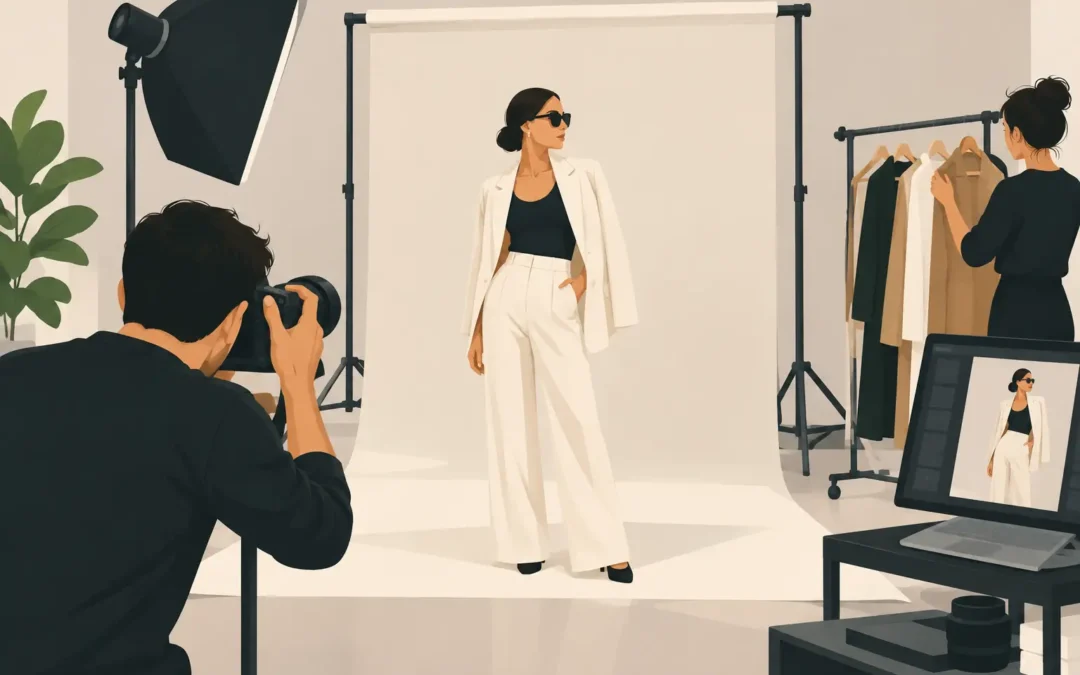
A strong fashion image can look effortless because the difficult decisions were made before anyone stepped onto set. This guide to fashion shoot production is for the point where a visual idea must become a working day: a photographer’s perspective, a stylist’s pull, a subject’s presence, a location’s limitations, and a client’s real need for usable images.
The goal is not to make production feel bureaucratic. It is to protect the image. A well-produced shoot gives the photographer and subject enough structure to work freely, while ensuring the final work has continuity, purpose, and a clear visual point of view.
Begin With the Image, Not the Equipment
Before a budget, crew list, or location search, define what the photographs should communicate. “Editorial” and “luxury” are not concepts. They describe a category or an ambition, not the emotional temperature of the work.
A useful treatment is concise. It identifies the subject, silhouette, palette, pace, light, framing, and degree of polish. It also establishes what should be resisted. If the work needs tension, overly flattering light may work against it. If the story depends on movement, a pristine studio set may be less useful than a location with real texture and room to breathe.
This is where a reference deck earns its place. References should clarify decisions rather than become a collage of borrowed images. Show the team how the light falls, how close the camera sits to the subject, what kind of styling volume is desired, and whether the work should feel observed, staged, intimate, graphic, or cinematic. Leave room for the people involved to bring their own intelligence to the day.
The brief should also identify the intended use. A magazine feature, a beauty story, a designer lookbook, and a paid campaign can share a visual language, but they are produced differently. Campaign work often requires more variation for crops, copy space, retouching, and paid media. An editorial story may benefit from fewer, more exact frames. Trying to satisfy every format at once can dilute the shoot.
Build the Production Around Real Constraints
Fashion production is a chain of dependencies. Casting affects tailoring. The location affects permitting, power, sound, changing space, and weather cover. The call time affects hair and makeup, daylight, and the subject’s availability. Small omissions tend to appear later as expensive problems.
Start with a budget that separates creative priorities from operational necessities. The visible line items are familiar: photographer, stylist, hair and makeup, talent, assistant, digital technician, equipment, studio or location, transportation, catering, and post-production. Less visible costs deserve equal attention: insurance certificates, permits, fitting time, messengers, garment steaming, parking, overtime, kit fees, production supplies, and contingency.
Contingency is not a sign of uncertainty. It is what allows a team to respond calmly when a delivery is late, rain changes a plan, or a look needs an additional alteration. On a small editorial production, it may be modest. On a campaign with talent, multiple locations, and a fixed launch date, it should be more substantial.
The producer, if one is involved, is not simply there to manage invoices. Their value is in protecting time and making decisions legible. On leaner crews, those responsibilities may sit with the photographer, creative director, or a trusted production coordinator. The principle remains the same: one person needs a current view of the plan, the permissions, the schedule, and the next decision.
The call sheet should answer practical questions
A call sheet is most useful when it reduces ambiguity. It should state addresses, parking and load-in instructions, contact numbers, call times, transportation, the nearest hospital if the production is substantial, weather conditions, wardrobe notes, and a schedule that includes setup, grooming, fittings, meals, and wrap.
Do not create a schedule that assumes every setup will go perfectly. Build in time for a subject to arrive, for a garment to be adjusted, and for the team to reset. A fashion set becomes strained when the schedule treats people as interchangeable equipment.
Casting and Styling Carry the Story
Casting is not only a matter of appearance. The person in front of the camera determines the energy of the frame. A model may bring precision and repetition. An artist, actor, founder, or musician may bring a more specific presence that changes the work entirely. The choice depends on the assignment and on what the images need to reveal.
Give casting the same attention as location scouting. Review a range of expressions, posture, movement, and prior work, but do not expect a person to reproduce a reference exactly. The best casting often creates a productive gap between the original treatment and the eventual image.
Styling should be developed with the frame in mind. Clothes can look extraordinary on a rack and fail once they are photographed. Consider proportion, fabric behavior, transparency, shoe height, jewelry scale, garment sound, and how a look performs sitting, walking, or standing in wind. Request a complete pull list before the shoot, then edit it. More options are useful only when there is time and space to manage them.
Confirm credits, loans, returns, and insurance responsibility before garments arrive. For commercial work, confirm usage restrictions as well. A piece available for an editorial may not be available for paid advertising, and an unclear agreement can undermine a strong production after the fact.
Scout for Light, Access, and Privacy
A location is a visual decision and a logistical one. The right room may have beautiful afternoon light but no freight elevator, limited power, difficult access for talent, or a restrictive shooting window. A street location may bring spontaneity, but it also introduces pedestrians, traffic, permits, weather, and less control over sound and background.
Scout at the approximate time of day you expect to shoot. Take reference photographs from likely camera positions, test practical power, locate restrooms and changing areas, and measure whether racks, carts, and lighting stands can move through the space. If the plan relies on daylight, establish a second visual approach in case conditions change.
Privacy matters particularly for recognizable subjects and public-facing campaigns. A contained environment can allow more concentration and more risk in the work. Conversely, an active public setting may be essential to the story. Neither is inherently better. The right choice is the one that supports the image without placing unnecessary pressure on the subject.
Direct the Day With Enough Room for Discovery
A fashion shoot should have a sequence, not a rigid script. Begin with the most essential images while energy, grooming, and schedule are intact. If one look is central to the story, do not leave it for the final hour. Build visual continuity by deciding early how each setup relates to the next: through color, gesture, setting, lens choice, or a shift in mood.
Keep communication direct. The subject needs a clear sense of what is being asked, particularly when the concept is abstract. Give simple adjustments, then allow a moment for the subject to find their own expression. The camera often registers over-direction immediately.
Review selects at sensible intervals rather than stopping after every sequence. Tethered capture can help a client, creative director, and photographer align on composition and coverage, but it can also slow the room if too many people begin directing from a monitor. Establish who has approval authority before the day begins.
Plan Delivery Before the First Frame
Post-production should reflect the intended finish, not repair a vague shoot. Agree in advance on the selection process, turnaround, retouching scope, file formats, naming conventions, and delivery method. For campaign work, specify crops, retouched finals, web exports, social variations, and any required background treatments. For editorial work, clarify publication deadlines, caption details, and credit requirements.
Usage should be stated in writing. Define where the images will appear, for how long, in which territories, and whether paid media, out-of-home, or third-party use is included. This is especially important when talent, location, music, artwork, or borrowed garments carry separate permissions.
The final delivery is not merely a folder of files. It is the point where the day becomes useful to an editorial team, a publicist, a creative director, or a brand. When production has been handled with care, the images arrive with their integrity intact – specific enough to be remembered, and organized enough to be put to work.