
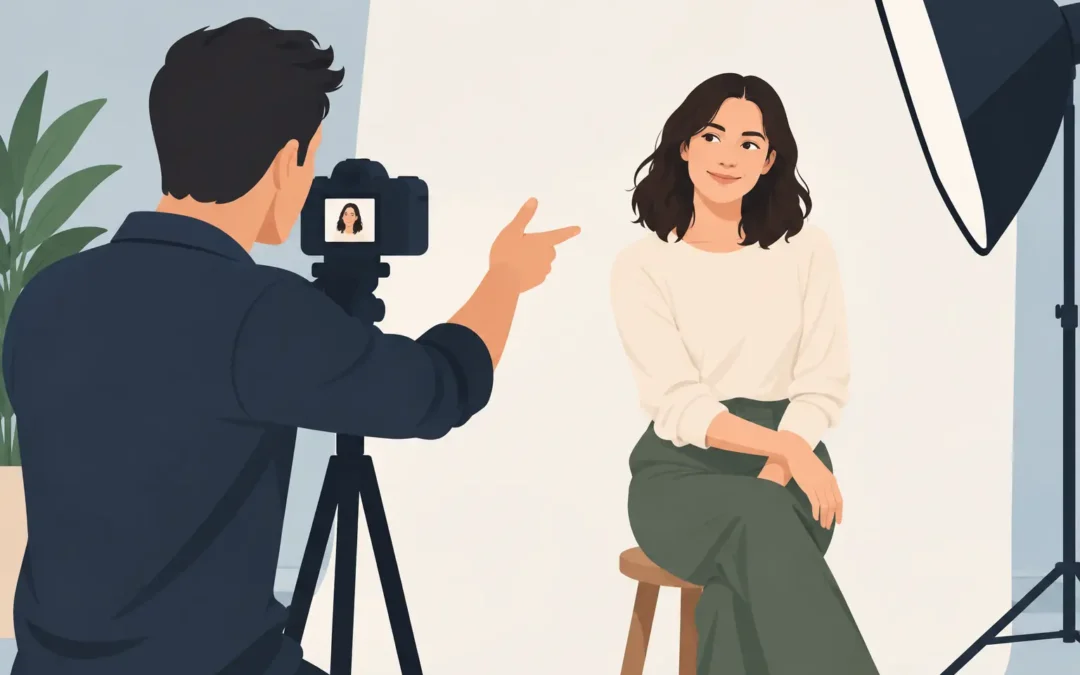
A portrait can lose its charge in the second a subject starts trying to look photographed. Knowing how to direct portrait subjects is less about supplying poses than creating conditions where a person can stay present, look considered, and give the camera something real.
For editorial assignments, campaigns, and artist portraits, direction is part of the visual language. It determines whether an image feels observed or overproduced, relaxed or vacant, precise or merely posed. The best direction is often quiet, but it is never accidental.
Begin Before the Camera Comes Up
Most useful direction happens before the first frame. A subject who understands the purpose of the shoot has less reason to perform a generic version of themselves. Brief them simply: where the photographs will appear, what atmosphere you are building, how much time you have, and whether the work should feel formal, intimate, graphic, cinematic, or immediate.
This does not require a long creative presentation. A few clear references and a specific sentence about the desired energy are usually enough. “We are keeping this spare and direct,” lands better than a stack of vague adjectives. “I want the frame to feel like you have just paused in the middle of a thought,” gives someone a usable place to begin.
For public figures and experienced talent, preparation also signals respect. They may arrive with a practiced relationship to the camera, a limited window, and a team waiting nearby. A photographer who has made decisions about light, background, framing, and wardrobe before the subject enters the room makes space for the human part of the session.
How to Direct Portrait Subjects Without Overposing
Direction works best when it gives the subject one thing to do at a time. Asking someone to relax, look natural, and be confident is not direction. It asks for a result without offering a path.
Start with the foundation: feet, weight, shoulders, hands, and eyeline. Instead of rearranging every limb at once, make one adjustment and watch what it changes. Ask them to put their weight into one hip, let one shoulder fall, turn their chest slightly away from camera, or bring their eyes back toward the lens. Then pause. A small correction can reorganize the whole frame.
Use language that describes an action rather than a flaw. “Let your hand have a little more weight” is more useful than “Your hand looks awkward.” “Bring your chin forward one inch, then down slightly” is clearer than “Fix your jawline.” Specific instruction keeps the subject from feeling judged and keeps the energy moving.
There is a difference between directing a pose and directing attention. A pose gives shape; attention gives it life. Once the body is placed, direct the subject toward a thought, a point in the room, the sound outside the window, or a person just beyond camera. A quiet change in focus can be more revealing than a larger gesture.
Give prompts, then leave room
Over-direction can flatten a portrait as quickly as no direction. If every frame is accompanied by commentary, the subject begins waiting for instruction instead of inhabiting the moment. Give a prompt, photograph the response, and let the beat continue for a few seconds after you think you have the image.
Useful prompts are concrete and open enough to invite variation: “Stay there, but let your eyes move around the room.” “Keep the same position and take a breath out.” “Turn away from me as if you have heard something behind you.” “Do that again, slower.” These suggestions preserve structure while allowing the person to make the picture their own.
When a subject offers an unexpected movement, follow it. The best frame may appear just after the planned pose breaks. This is particularly true with artists, performers, and people accustomed to controlling their image. The goal is not to defeat that control. It is to make an image that has room for their intelligence inside it.
Build Trust Through Pace and Feedback
A portrait session has a tempo. Move too quickly and the subject never settles. Move too slowly and the room loses voltage. The right pace depends on the assignment, but a photographer should be decisive enough that a subject does not feel they are carrying the session alone.
Offer feedback that is honest and selective. Saying “great” after every frame makes the word meaningless. Better to identify what is working: “That angle is strong,” “The light is holding beautifully there,” or “That expression felt less performed. Stay close to it.” This lets the subject understand the direction without turning the monitor into a running critique.
Showing images can help, especially when the subject is uncertain about a pose or unfamiliar with your approach. It can also interrupt the rhythm if used too often. Consider sharing a frame after you have established the visual world, then return to shooting. The image should reassure, not invite constant self-editing.
Pay attention to the crew’s behavior as well. A crowded, chatty set can make a portrait subject feel watched from every angle. Keep the working area calm. Introduce necessary collaborators, make sure the subject knows where to look for direction, and reduce peripheral noise whenever possible. Privacy is often a practical tool, not a luxury.
Direct the Details That Change the Image
Portrait direction is not only about expression. Clothing, hair, hands, and posture are all part of the frame, and each can either support the photograph or pull attention from it.
Before shooting, look for tension: a collar caught under hair, a jacket pulled too tightly across the shoulders, fingers pressed flat against a thigh, a chin lifted past the light. Correct these details with care. If you need to touch the subject or adjust clothing, ask first. If a stylist is present, let them make the adjustment when appropriate. Small courtesies preserve trust, particularly in close, quiet portrait work.
Hands deserve patience. They are often where self-consciousness appears first. Give them a purpose: hold a lapel, rest lightly on an arm, touch the edge of a chair, place one thumb in a pocket, or let one hand disappear from frame. A hand rarely looks convincing when it has been told only to look relaxed.
Do not solve every imperfection. A slightly uneven collar, an unguarded blink between poses, or a face that is not arranged for maximum polish may be the detail that keeps the image from feeling sterile. The choice depends on the brief. Beauty work may demand control; an artist portrait may gain authority from irregularity. Refinement is not the same as erasure.
Adjust Your Language for the Person in Front of You
Some subjects want active direction. Others need one initial structure and room to work. Read the response rather than relying on a fixed script.
A nervous first-time subject may benefit from practical reassurance: explain where to stand, demonstrate the movement if useful, and acknowledge that the camera can feel strange at first. Give them early wins with simple positions. Avoid telling them to be comfortable before they have any reason to feel that way.
An experienced actor or musician may respond better to intention than mechanics. Rather than repeatedly directing their face, describe the atmosphere and let them interpret it. If their choices drift away from the frame, bring them back with one clean technical adjustment. Respecting an accomplished subject’s instincts does not mean abandoning your point of view.
When working with a reserved person, conversation can help, but it should not become a tactic for extracting disclosure. Ask about the work, the place, or the immediate environment. Let silence remain available. Some people become more expressive when they are entertained; others become more themselves when no one asks them to perform sociability.
Know When to Stop Directing
The strongest portraits often arrive when the subject has absorbed the structure and you no longer need to narrate it. The light, composition, and relationship are doing their work. At that point, reduce your language.
Watch for the moment when a face becomes settled rather than posed. It may happen after a laugh fades, while the subject resets between instructions, or in the stillness after you say nothing. Keep shooting through those transitions. They are frequently where poise turns into presence.
A considered portrait does not need to announce the effort behind it. Give the subject clear boundaries, a calm set, and direction they can use. Then allow enough silence for the person in front of the lens to arrive.