
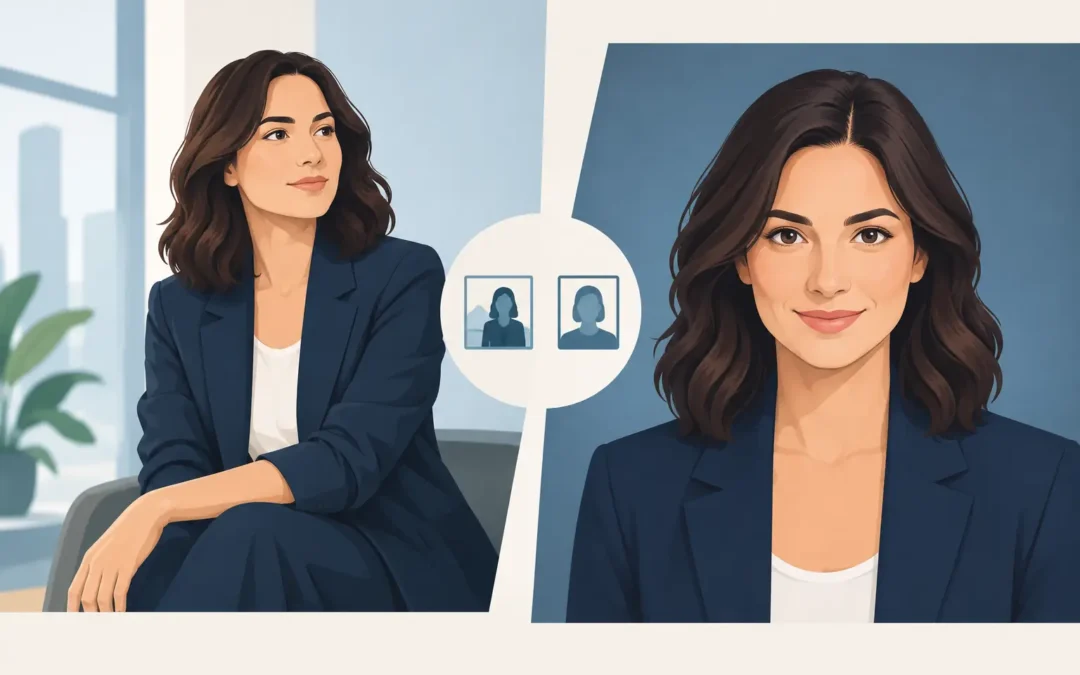
A face can be photographed in ten minutes and still take weeks of thought. That is the practical distinction behind portraiture versus headshots: one is usually designed to identify a person clearly; the other is designed to say something about who they are, what they make, or the moment they occupy.
For editorial teams, publicists, creative directors, and brands, the choice shapes more than the final crop. It affects the brief, the location, the time required, the level of collaboration, and the life an image can have after publication. A strong commission begins by deciding what the image needs to communicate before deciding how closely the camera should move in.
Portraiture versus headshots: different assignments
A headshot is a focused, functional image. It gives the viewer an immediate and credible sense of a person’s appearance. The subject is generally looking toward camera or held in a composed, accessible pose. Background, lighting, and styling are controlled to keep attention on the face.
That clarity makes headshots useful for press releases, speaker pages, casting materials, professional bios, author jackets, agency rosters, and corporate communications. Consistency is often part of the assignment. A publicist may need an image that feels current, polished, and easy for editors to place beside a short announcement. An organization may need several people photographed in a shared visual language.
Portraiture has a wider field of interest. It may show a subject at home, in a studio, backstage, on a street, or within an environment that introduces tension or meaning. The face remains central, but it is not always the only point. Gesture, wardrobe, color, objects, architecture, and the quality of light can all carry information.
A portrait of a novelist in an empty theater, for example, can suggest a public life, a private temperament, or a body of work without explaining any of it literally. The image has room for implication. It is less concerned with proving that the subject looks like their current press photo and more concerned with making the viewer stay with them.
Neither format is inherently more valuable. A clean headshot can be exacting and elegant. A portrait can become overproduced when an idea overwhelms the person. The right choice depends on whether the assignment calls for recognition, interpretation, or a considered balance of both.
Start with the image’s destination
The most useful question is not, Do we want a portrait or a headshot? It is, Where will this photograph be seen, and what should it accomplish there?
For a contributor page, conference program, or talent announcement, a headshot often answers the brief efficiently. Editors need a readable image at a small size, with enough visual calm to sit beside typography. The photograph should be current and unmistakably the subject.
For a magazine feature, campaign launch, artist profile, or cultural project, portraiture can do more work. It can establish a visual world that supports the story before a reader reaches the first line. A music publication may need an artist pictured with enough atmosphere to hold a full-page opener. A beauty brand may need a face that feels precise but not interchangeable. A portrait gives art direction a place to live.
Usage also matters. A headshot often needs longevity and broad utility. Portraiture may be made for a particular story, season, collection, or release, although the strongest images can travel well beyond their original context. If a client needs both a widely usable press image and material with editorial character, it is often wise to commission a session that intentionally produces both.
What changes on set
The difference is visible long before the shutter is pressed. A headshot session usually prioritizes speed, repeatability, and confidence. The photographer establishes a flattering light pattern, an uncomplicated setting, and a clear direction for expression. Small adjustments matter: the angle of the chin, the fall of a collar, the relationship between the eyes and lens.
Portraiture tends to allow more discovery. The conversation may be longer. The subject may move through several locations or changes of clothing. There is more room for chance, but chance needs structure. A seemingly unguarded frame is often the result of careful pacing, a considered set, and an atmosphere in which the subject can stop performing familiarity.
Light carries a different kind of information
In a headshot, light is generally in service of legibility. It should describe the face without distraction, preserve skin tone, and reproduce predictably across platforms. Drama is possible, but it must not compromise recognition.
In portraiture, light can become part of the narrative. Hard afternoon sun can make a subject feel exposed or cinematic. A dim interior can create privacy and distance. Flash can bring an editorial sharpness that separates the person from their setting. These are not decorative decisions. They affect what the viewer assumes about the subject.
Environment is not background decoration
A neutral backdrop is often appropriate for a headshot because it removes competing information. In portraiture, an environment earns its place when it reveals something specific: an artist’s working rhythm, an executive’s relationship to a place, a performer’s offstage presence, or a brand’s material world.
The setting should not simply announce production value. A beautiful room with no connection to the person can flatten a photograph into generic luxury. Often a single chair, a window, a threshold, or a field of color is enough.
Expression cannot be forced into a category
Clients sometimes ask for a headshot that feels candid, or a portrait that feels polished enough for press. Those requests are not contradictory. They simply require more precise direction.
A useful headshot does not need a broad smile. Composure, warmth, intelligence, and reserve can all be credible expressions. What matters is that the subject appears present. A vacant or overly managed expression weakens the image, even when the lighting is technically perfect.
A portrait does not need to be visibly emotional to have depth. Stillness can be revealing. So can a subject looking away from the camera, provided the decision has a purpose. The strongest portraiture avoids treating personality as a performance to extract. It creates conditions where a person can be seen with some complexity intact.
That distinction matters especially for public figures and creative subjects who have been photographed repeatedly. They may arrive with practiced poses and a familiar public image. A good commission respects that experience while finding a frame that does not feel prepackaged.
When one session should produce both
Many assignments benefit from a dual approach. A publication may need a close, usable image for its contributor database and a more expansive portrait for the feature. A talent representative may need current press assets alongside photographs that can support interviews, social channels, and future announcements. A brand can need a direct founder image as well as a campaign-facing visual with more atmosphere.
The practical solution is not to treat the headshot as an afterthought. Build it into the schedule. Begin with the clean, straightforward frame while hair, makeup, and energy are fresh. Then widen the visual language through changes in light, location, wardrobe, or pace. This sequence protects the essential deliverable while leaving space for images that may become the more enduring ones.
It also helps to set expectations with the subject. Someone asked to provide a professional headshot should not be surprised by a location-driven editorial production. Someone commissioned for a portrait should understand that the process may ask for more time and more openness than a standard press session. Clear preparation makes the camera feel less transactional.
Commission with a visual point of view
The best photography briefs leave room for expertise. A client should be clear about usage, deliverables, brand considerations, schedule, and the subject’s public context. But a detailed shot list cannot substitute for a point of view.
Before commissioning, consider the relationship between the subject and the intended audience. Is the person already recognizable? Does the story need intimacy, authority, glamour, strangeness, or restraint? Will the image sit in a grid of other assets, open a feature, or be reproduced at billboard scale? These decisions determine whether the work should prioritize consistency or visual specificity.
For high-visibility subjects, polished portraiture can also be a form of editorial positioning. It signals that a release, profile, or collaboration has been considered beyond its basic announcement. That does not require spectacle. It requires an image with enough intention to hold attention after the surrounding copy has changed.
A headshot tells people who they are looking at. A portrait gives them a reason to look longer. The most effective commission knows which of those tasks matters first, then gives the photographer enough clarity and room to make the image feel inevitable.