
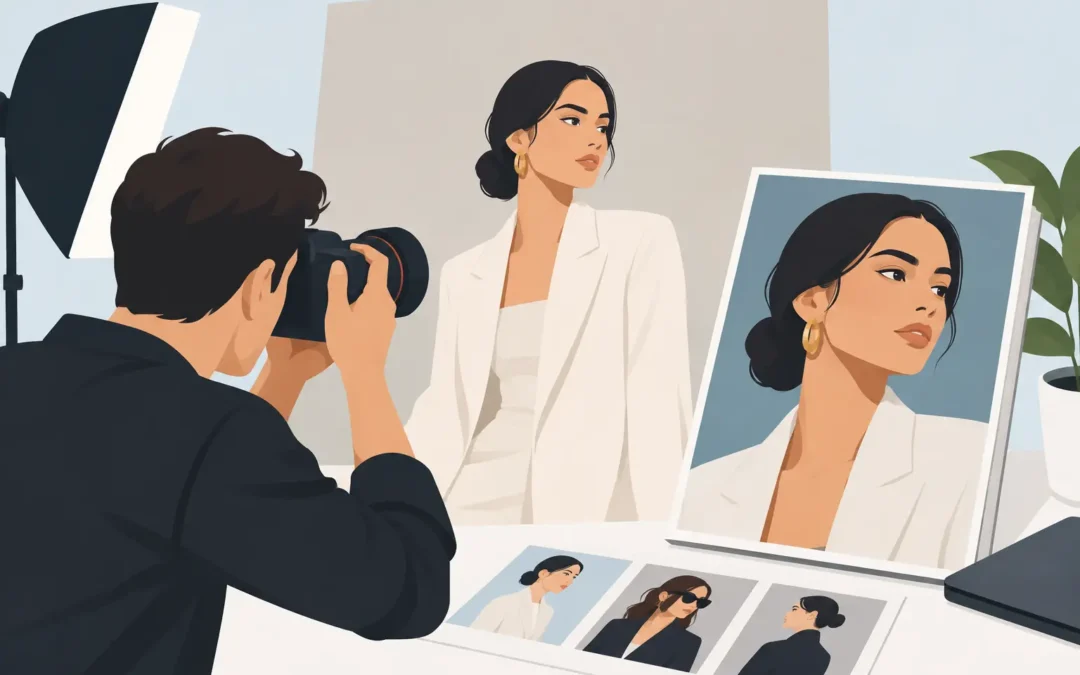
A cover has to work before a reader opens the magazine. It must carry a subject’s presence, the publication’s identity, and the issue’s point of view in one frame – often at thumbnail size, on a crowded newsstand, or in a fast-moving social feed. The best photographers for magazine covers understand that the assignment is not simply a portrait session. It is an editorial decision with commercial, cultural, and practical consequences.
A compelling cover image makes room for both the person and the publication. It holds attention without turning the subject into a prop. It gives a designer usable space for type while retaining enough tension, detail, or expression to make the image feel alive. Those demands are why a photographer’s portfolio matters more than a generic promise of technical capability.
What Makes a Magazine Cover Photographer
Magazine cover photography asks for a rare combination of authorship and discipline. A photographer needs a recognizable visual intelligence, but that intelligence has to serve the story. An image that is beautiful in isolation can still fail as a cover if the subject disappears under the masthead, the composition offers no room for cover lines, or the mood conflicts with the issue.
The strongest photographers think about the final use from the beginning. They consider vertical and horizontal crops, alternate framing, the placement of a logo, and how an image will reproduce in print and on screen. That does not mean every image should be built like an advertisement. It means the work should preserve editorial possibility.
Just as important is the ability to work with people whose time, attention, and public image are closely managed. A cover subject may arrive between interviews, with a publicist watching the clock and a team already invested in a particular narrative. The photographer’s job is to create enough calm and clarity for an unforced moment to happen. That is not achieved through volume. It comes from preparation, confidence, and a sensitive read of the person in front of the camera.
Finding the Best Photographers for Magazine Covers
The right choice begins with the publication’s real objective. A fashion-forward title, an arts journal, a celebrity weekly, and a business magazine may all commission portraits, but they are not asking for the same thing. One may need visual transformation. Another may need intimacy and restraint. A third may need a powerful likeness that feels immediate and unmistakably current.
Start with the photographer’s body of work rather than one successful image. Look for consistency of judgment across different subjects, locations, lighting conditions, and levels of production. The question is not whether every photograph looks alike. It is whether the photographer’s choices feel intentional. A portfolio should show that the artist can find structure in a face, direct a set without overworking it, and maintain a point of view when circumstances change.
Named portrait projects can be especially revealing. They show whether the photographer can create an image that belongs to a particular person rather than applying the same visual formula to everyone. For editorial clients, this distinction is substantial. A cultural figure, actor, founder, musician, or writer does not need to be made generic in order to look polished. The best work allows individuality to remain visible.
Look beyond polish
Technical polish is expected. Clean lighting, accurate color, thoughtful retouching, and controlled composition are the baseline for a high-profile commission. They are not, by themselves, the reason an editor remembers an image.
Look for pictures that imply a relationship between photographer and subject. Is there alertness in the expression? Does the posture feel directed but not frozen? Is the setting part of the story, or merely expensive scenery? A cover portrait often has very little time to communicate. The frame needs an emotional or intellectual charge that survives reduction, cropping, and repetition.
This is where a portfolio with range can matter. Range does not mean a photographer should imitate every trend. It means they can decide when a subject needs hard flash, soft daylight, architectural space, saturated color, or a nearly bare background. A photographer with a fixed signature can be an excellent choice when that signature is exactly what the issue requires. When the story is still developing, a broader command of mood and production may be more useful.
Assess how the work supports design
Photography and cover design are separate disciplines, but they must anticipate each other. An editor does not need a photographer to design the cover. They do need someone who understands the image as a working surface for design.
Review images with a practical eye. Is there variation in framing? Are there close portraits as well as wider options? Does the photographer deliver a hero image with enough clean space for a masthead or cover lines without making the image feel empty? Are details in dark areas and highlights likely to reproduce well?
The most useful cover sessions produce choices. That does not mean indiscriminate overshooting. It means developing a controlled set of distinct answers: a direct portrait, a looser frame, a more graphic option, and an image with a different emotional temperature. Editors and art directors need room to make a strong final decision after the shoot, especially when text, image sequencing, and late editorial changes enter the process.
The Assignment Is Also a Production Test
A photograph can only be as successful as the conditions that allow it to be made. For cover work, the photographer should be able to translate a creative brief into a workable production plan: crew, schedule, location, permits, equipment, styling coordination, digital workflow, and delivery timing.
This is particularly relevant when talent access is limited. A photographer who needs hours to find the picture may not be the right fit for a 20-minute hotel suite session. Conversely, a tightly scheduled subject does not automatically call for a minimal approach. An experienced photographer can arrive with a precise visual plan, establish the lighting before the subject enters, and still leave space for an unexpected expression or gesture.
Ask how the photographer approaches preproduction. The answer should be specific without becoming overly complicated. Good collaborators can discuss references, location logic, wardrobe considerations, image usage, and the number of required setups in direct terms. They know which decisions need approval early and which can remain flexible on set.
The trade-off is worth acknowledging: a highly produced cover can create distinction and press value, but it adds dependencies, cost, and opportunities for delay. A simple portrait can feel more urgent and contemporary, but only if the photographer knows how to make simplicity intentional. The appropriate scale depends on the subject, the publication, and what the issue needs to say.
A Clear Brief Protects the Photograph
The strongest commissions begin with a brief that leaves no uncertainty about the essentials. Share the issue’s editorial premise, the intended cover date, the subject’s availability, expected usage, required orientation, and any nonnegotiable visual considerations. If the magazine has an established visual identity, say whether the assignment should extend it or challenge it.
It also helps to describe what should be avoided. Perhaps the subject is weary of conventional studio portraits. Perhaps the publication wants no overt glamour, no obvious celebrity shorthand, or no imagery that feels too campaign-like. Negative direction can save time when it is stated thoughtfully.
Then give the photographer enough room to interpret. Editorial photography loses force when every decision is predetermined by committee. The reason to commission a photographer with a distinct portfolio is to invite their eye into the process. Clear parameters and creative trust are not opposites. They are the conditions that allow a cover image to feel considered rather than manufactured.
Choose for the Image You Need to Remember
The right photographer is not necessarily the most visible name, the largest production, or the person with the most social reach. It is the artist whose work makes sense for this subject, this publication, and this moment. Their portfolio should make that case quietly, through images that feel composed, psychologically alert, and hard to confuse with anyone else’s.
A cover is a public object, but its power often begins in a private instant: a shift in attention, a refusal to perform, a subject briefly seen without the usual protective surface. Choose the photographer who can recognize that instant, and who knows exactly how to hold it.